Sunday, April 7, 2013

To Be the Frenemy of a Queen

The Confession of Katherine Howard by Suzannah Dunn

Summary: When twelve-year-old Katherine Howard comes to live in the Duchess of Norfolk’s household, poor relation Cat Tilney is deeply suspicious of her. The two girls couldn’t be more different: Cat, watchful and ambitious; Katherine, interested only in clothes and boys. Their companions are in thrall to Katherine, but it’s Cat in whom Katherine confides. Summoned to court at seventeen, Katherine leaves Cat in the company of her ex-lover, Francis, with whom Cat begins a serious love affair.

Within months, the king has set aside his latest wife for Katherine. The future seems assured for the new queen and her maid-in-waiting, although Cat would feel more confident if Katherine hadn’t embarked on an affair with one of the king’s favoured attendants, Thomas Culpeper.

For a blissful year and a half, it seems that Katherine can have everything she wants. But then allegations are made about her girlhood love affairs. Desperately frightened, Katherine recounts a version of events which implicates Francis but which Cat knows to be a lie. With Francis imprisoned in the Tower, Cat alone knows the whole truth of Katherine Howard’s past.

Review: A tale of an easy to despise Katherine Howard told from the point of view of a catty friend.

I’m not a big fan of the term frenemy, but it perfectly describes Cat’s feelings toward Katherine. Cat is very quick to say how colorless Katherine is, how she is just a tiny girl, and how uneducated she is. Katherine is quick to impress everyone even though she doesn’t have a thought in her brain. The reader only gets an outside perspective of Katherine and I was not a big fan of her. She seemed quite frivolous and only concerned about her own pleasure.

It may not be historically accurate, but I would prefer a more balanced portrayal of Katherine. A Katherine that is both excited and scared to be queen, a Katherine that just wants love from someone her own age, a Katherine that is perhaps a bit naïve. I don’t know why Cat stayed friends with Katherine if she disliked her so much. Cat is not a good friend. She is only thinking of her boyfriend when she spills the beans about the queen and Thomas Culpepper. Cat tries to make herself feel better after the fact, but it doesn’t convince anyone. I also didn’t like the use of so much modern language. I know it would be hard to tell a story during this time period in the English they used, but I appreciate not having to see too many modern words in the story. 

Rating:


Recommendation: I would recommend this book to those interested in the Tudors, especially the queens of Henry VIII. 

Saturday, April 6, 2013

Bleeding 'Em Dry

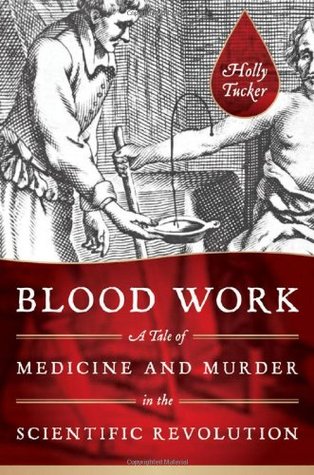
Blood Work: A Tale of Medicine and Murder in the Scientific Revolution by Holly Tucker

Summary: On a cold day in December 1667 the renegade physician Jean Denis transfused ten ounces of calf's blood into Antoine Mauroy, a madman. Several days and several transfusions later, Mauroy was dead and Denis was framed for murder. A riveting and wide-reaching history, Blood Work shows how blood transfusion became swept up in personal vendettas, international intrigues, and the war between science and superstition. In a foreshadowing of today's stem cell and cloning debates, proponents saw transfusion as a long-awaited cure to deadly illnesses, while others worried that science was toying with forces of nature, perhaps even paving the way for monstrous hybrid creatures. Taking us from the highest ranks of society to the lowest, Holly Tucker introduces us to an unforgettable cast of characters, all ruthless contenders in the battle over transfusion. Finally, in a feat of historical research, she reveals the true identities of Mauroy's murderers—and their motivations to kill.

Review: A tale of blood transfusion, murder, rivalries, and a good dose of medical history.

For me, history is a fascinating subject, especially medical history. It allows you a glimpse into what people’s lives were like hundreds of years ago. It really is incredible how far we have come in the past hundred years. There are so many new advances that would have been unimaginable to people hundreds of years ago. I am glad to live in such a medically advanced age. Medical histories can be downright scary. I cringe when I think about a time when bleeding people was considered a standard medical practice.

I felt so bad for all the poor animals that were killed or tortured during experiments with blood and blood transfusion. As terrible as it is, they didn’t seem to have any other way to learn about blood. You couldn’t use dead bodies since they had no blood flow. It was fascinating to learn about what they thought that blood transfusion would do to people, including turning them into the animal from whence they had gotten the blood from. I can only imagine how far blood transfusion could have gotten if it wasn’t stopped so early in its tracks. 

Rating:


Recommendation: I would recommend this book to those that enjoy medical history. 

Friday, April 5, 2013

Snowmen Warm the Heart

The History of the Snowman: From the Ice Age to the Flea Market by Bob Eckstein

Summary: The snowman appears everywhere on practically everything -- from knickknacks to greeting cards to seasonal sweaters we plan to return. Whenever we see big snowballs our first impulse is to deck them out with a top hat. Humorist and writer Bob Eckstein has long been fascinated by this ubiquitous symbol of wintertime fun -- and finally, for the first time, one of the world's most popular icons gets his due.
A thoroughly entertaining exploration, The History of the Snowmantravels back in time to shed light on the snowman's enigmatic past -- from the present day, in which the snowman reigns as the King of Kitsch, to the Dark Ages, with the creation of the very first snowman. Eckstein's curiosity began playfully enough, but soon snowballed into a (mostly) earnest quest of chasing Frosty around the world, into museums and libraries, and seeking out the advice of leading historians and scholars. The result is a riveting history that reaches back through centuries and across cultures -- sweeping from fifteenth-century Italian snowballs to eighteenth-century Russian ice sculptures to the regrettable "white-trash years" (1975-2000).
The snowman is not just part of our childhood memories, but is an integral part of our world culture, appearing -- much like a frozen Forrest Gump -- alongside dignitaries and celebrities during momentous events. Again and again, the snowman pops up in rare prints, paintings, early movies, advertising and, over the past century, in every art form imaginable. And the jolly snowman -- ostensibly as pure as the driven snow -- also harbors a dark past full of political intrigue, sex, and violence.
With more than two hundred illustrations and a special section of the best snowman cartoons, The History of the Snowman is a truly original winter classic -- smart, surprisingly enlightening, and quite simply the coolest book ever.
Review: A very thorough and impressive book about the history of the snowman. 
I love snowmen. I always thought they were cute, but sometime during the past few years, it has turned into a great love. As am I writing at my desk, I have three snowman figures on my desk, a tissue box with a snowman on it, and am drinking tea out a giant snowman mug. Perhaps I’m slightly obsessed, only slightly though. I’ve wanted to read this book ever since I saw it although I wasn’t sure how much history could possibly be associated with a snowman.

I was certainly proved wrong though. I thought snowmen were a relatively recent invention, perhaps in the last 150 years or so. I did not realize how far back snowmen went in time. They don’t always look like the traditional snowmen of today, but they certainly have an interesting history. This book was told from the present back. There was a good deal of information in the most recent years, but it got more scant as time went on. A lot of the older time periods dealt with snow sculptures, not so much snowmen. As much as I love snowmen, I don’t think they were as important as the author made them out to be. 

Rating:


Recommendation: I would recommend this book to those that love snowmen. 

Thursday, April 4, 2013

Quite a Stick in the Mud

A Lady Awakened (Blackshear Family #1) by Cecilia Grant

Summary: Newly widowed and desperate to protect her estate and beloved servants from her malevolent brother-in-law, Martha Russell conceives a daring plan. Or rather, a daring plan to conceive. After all, if she has an heir on the way, her future will be secured. Forsaking all she knows of propriety, Martha approaches her neighbor, a London exile with a wicked reputation, and offers a strictly business proposition: a month of illicit interludes . . . for a fee.

Theophilus Mirkwood ought to be insulted. Should be appalled. But how can he resist this siren in widow’s weeds, whose offer is simply too outrageously tempting to decline? Determined she’ll get her money’s worth, Theo endeavors to awaken this shamefully neglected beauty to the pleasures of the flesh—only to find her dead set against taking any enjoyment in the scandalous bargain. Surely she can’t resist him forever. But could a lady’s sweet surrender open their hearts to the most unexpected arrival of all . . . love?

Review: A prim and proper stick in the mud marries handsome man and lived happily ever after?

I liked the premise of this book. I imagined the initial awkward interactions and how Martha would come to love Theo. I did not think how prim and proper Martha would be. I’ve read other books, The Devil’s Waltz, with prim and proper ladies who blossom with the right man to love them. Unfortunately, Martha continued to stay a stick in the mud throughout the whole book. Theo does get her to open up a bit, but very little. He believes he loves her, but I am not sure if he will ever get Martha to truly open up. I can only imagine how married life would be.

Why was she such a stick in the mud? Martha mentions a strict and proper governess, but how much the governess and how much is Martha’s natural inclinations. She was quite young. I know that she had no interest in marrying for love and married merely so she would not be a burden on her family. I do admire her wishing not to be a burden on her family, but she winds up unhappy in her marriage. I don’t think anyone would have minded if she tried to find a man to marry who was closer to age or more like her temperament. 

Rating:


Recommendation: I would recommend this book to those that enjoy historical romance with prim and proper ladies being not so prim and proper. 

Wednesday, April 3, 2013

More Than a Few Days in 2056

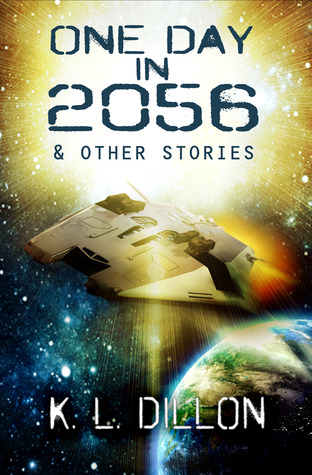
One Day in 2056 & Other Stories by K.L. Dillon

Summary: “People just can’t die. There has to be consequences,” a grief-stricken Alex Pine says to Dr. Hailey Madison in “Come What May,” the first of six short stories. After his mother’s suicide, Alex’s life starts to spin out of control. Alone and desperate for answers, Alex pays his mother’s psychiatrist a visit, gun in hand. 

The collection’s title story, “One Day in 2056”, revolves around 14 year old Harold George Wells. In 2050, five billion people were mysteriously abducted and it may have something to do with the “UFO-looking ships” occupying the earth’s skies. However, out of the five billion that were taken, Harold only cares about two: his parents.

In “Nineteen,” aspiring writer and Hemingway enthusiast Jacob Fisher drops out of college to pursue his dream of becoming a novelist. But, after he’s disowned by his parents and kidnapped by a group of scientists, whose sole intention is to send him back in time to make a different choice, he begins to question his fate and destiny and whether or not everything’s not already written in stone.

Disclaimer: I received this book form the author in exchange for a review. 

Review: A mix of both good and meh short stories.

From the title, I thought the short stories in this collection would be science fiction. However, after reading the book, I would consider only one story to be science fiction with another story being close. While I was a little disappointed, I still did enjoy this book. My favorite out of this collection was “Moving On”. It was very poignant.  “Moving On” dealt with grief, the unreality of reality, and how quickly it is to lose oneself. “The Urn” was another story dealing with grief. It was quite eerie since you are not sure if it’s all in his head or something else entirely.

“Come What May” was tragic. I knew something bad would happen at the end, but I was hoping that someone would come in and save the day. The story certainly does a good job of reminding us to be grateful for what we have while we have it and never take it for granted. I always say I love you to my husband every time I leave for a reason. “One Day in 2056” had a big buildup, but the ending was a bit of a letdown. The story could easily be expanded into a full length novel.

I wasn’t sure what the point was of “Nineteen”. It was a fine story about a young man who dropped out of college. I was expecting something to happen to him that would either make him change his mind or make him realize he was meant to be a writer. Then it gets weird when he gets kidnapped by scientists to send him back in time. The ending made me wonder what the whole point of the story. “The Fourth Couple” was my least favorite. It was overly dramatic and ridiculous and felt like an excuse to put in violence and suicide in a story.   

Rating:


Recommendation: I would recommend this book to those that enjoy short stories. 

Tuesday, April 2, 2013

If I Can't Have It, No One Can

The Man Who Loved Books Too Much: The True Story of a Thief, a Detective, and a World of Literary Obsession by Allison Hoover Bartlett

Summary: In the tradition of 'The Orchid Thief', a compelling narrative set within the strange and genteel world of rare-book collecting: the true story of an infamous book thief, his victims, and the man determined to catch him.

Rare-book theft is even more widespread than fine-art theft. Most thieves, of course, steal for profit. John Charles Gilkey steals purely for the love of books. In an attempt to understand him better, journalist Allison Hoover Bartlett plunged herself into the world of book lust and discovered just how dangerous it can be.

Gilkey is an obsessed, unrepentant book thief who has stolen hundreds of thousands of dollars' worth of rare books from book fairs, stores, and libraries around the country. Ken Sanders is the self-appointed "bibliodick" (book dealer with a penchant for detective work) driven to catch him. 

Bartlett befriended both outlandish characters and found herself caught in the middle of efforts to recover hidden treasure. With a mixture of suspense, insight, and humor, she has woven this entertaining cat-and-mouse chase into a narrative that not only reveals exactly how Gilkey pulled off his dirtiest crimes, where he stashed the loot, and how Sanders ultimately caught him but also explores the romance of books, the lure to collect them, and the temptation to steal them. 

Immersing the reader in a rich, wide world of literary obsession, Bartlett looks at the history of book passion, collection, and theft through the ages, to examine the craving that makes some people willing to stop at nothing to possess the books they love.


Review: An intriguing tale of the world of rare books, those who loves them, and those who will do anything to get them. 

I love rare books. I want to be a rare book librarian. I look forward to the day when I know enough Latin to read books written in the language. So I can understand the love and desire to obtain rare books or even just to hold them. The book only scratches the surface of rare books and rare book collecting, but does a good enough job to give the audience a general idea of what it's all about. I want to visit rare book stores and rare book fairs even more now.

I couldn't stand Gilkey. I can understand his desire to acquire rare books by any means possible although I could never condone stealing them. I couldn't believe that Gilkey actually felt entitled to these books just because he didn't have enough money to buy them. I was impressed by the job that Sanders did in tracking down Gilkey. The reaction of law enforcement to Gilkey's crimes was disheartening. Some people don't seem to realize how important rare books are to our society and our culture. 

Rating:


Recommendation: I would recommend this book to those interested in books, rare books, and literary culture. 

Monday, April 1, 2013

It's Monday! What Are You Reading?


It's Monday! What Are You Reading? is a meme hosted by Book Journey. This meme lets you show fellow readers what you have read, what you are reading, and what you will be reading.

Recently Read:

Currently Reading:


To Read: